The plate
A streak test is one of the cheapest things in mineralogy and one of the few that cannot be argued with. You draw the specimen once across a tile of unglazed porcelain and look at what it leaves. The powder is the mineral with its lustre and its crystal habit taken away, and it is far more constant than the lump.
£18 a specimen · Read within a fortnight of arriving
The plate is the reference, not the light
You do not read a streak against daylight or against a lamp; you read it against the plate it is sitting on, which is the same plate every time. That is what makes the test portable — two people in two rooms compare powder to porcelain, not powder to memory.
Every photograph on this site is treated the same way. The bare, unmarked part of the plate is measured in each file, and the whole frame is then scaled in linear light by one gain per channel until that bare plate reads L* 94, a* 0, b* 0. Nothing is done to any region on its own and nothing is done per pixel, so the scaling can only rescale a colour that was already in the frame — it cannot invent one. After it, a difference between two photographs here is a difference between two specimens rather than between two afternoons.
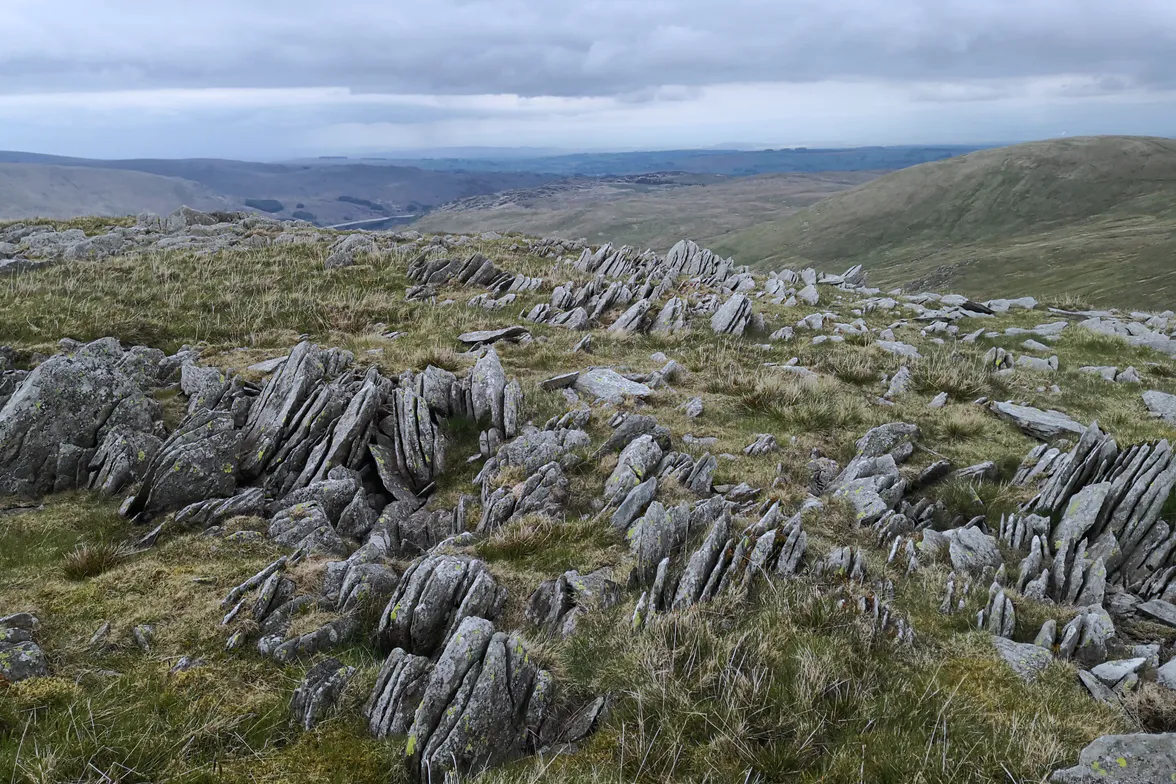
The photographs taken out of doors get the same operation and cannot get the same reference, because there is no porcelain in a quarry. Each of those declares its own grey instead — a bank of cloud, a bare limestone clint, the mist, the paper of the notebook — and is scaled by one gain per channel until that patch is neutral, keeping the lightness it already had. The patch is written down with the photograph in data/field.mjs and measured back off the shipped file by scripts/field-check.mjs, which also fails if a master turns out to have needed no correction at all. A grade that moved nothing is not a treatment.
There is a guard on it, and it earned its place on the first run. Left to pick its own reference, the script chose the bluest part of the sky over the moor gate, decided that was what grey looked like, and asked for a gain of 807 on the red channel. Nothing in the arithmetic objected. A patch above C* 12 is now refused outright, by name, before anything is written.
What the numbers came out at
Measured back off the shipped files rather than off the script that wrote them: across all 30 plate regions the bare porcelain sits at a mean lightness of 94.09, no file is more than 0.19 away from the target, and no file carries more than 0.42 of cast in either colour axis. The ungraded originals are kept and are measurably off: they run from L* 87.9 to L* 93.3 with up to 2.2 of yellow in them.

Two ways a specimen leaves the key
It is harder than the plate
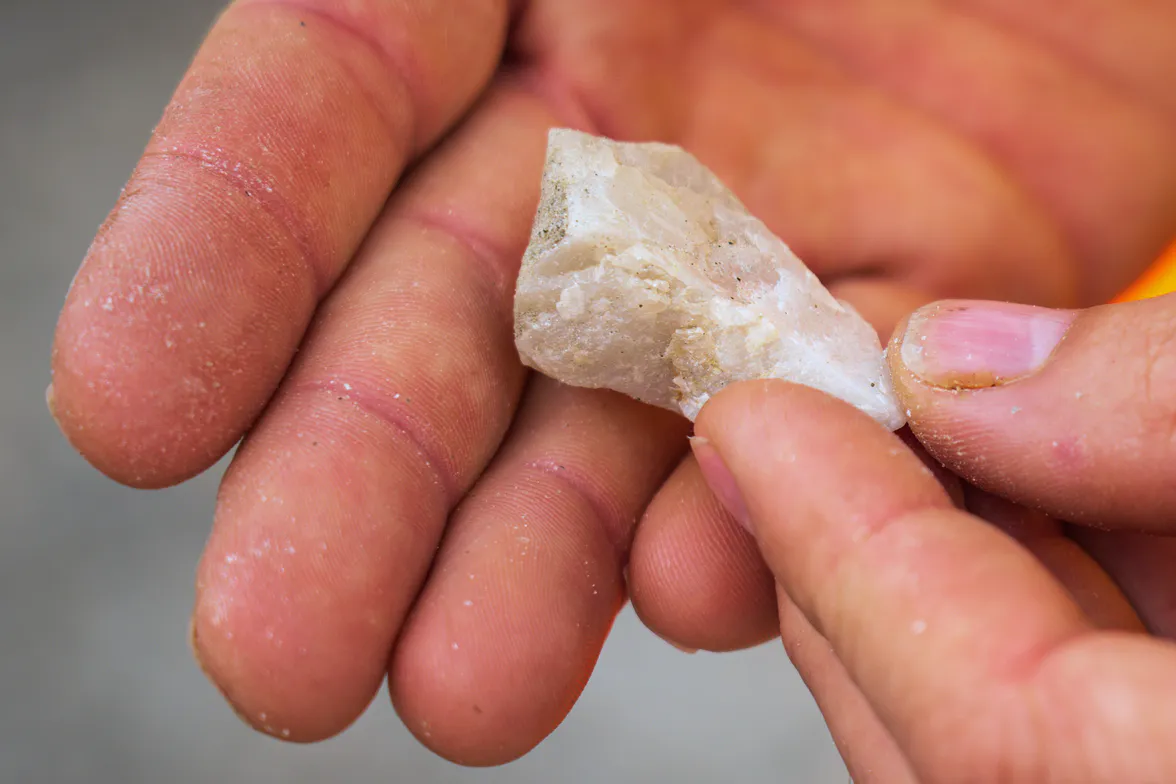
Unglazed porcelain is about Mohs 6.5. Anything above that does not powder against it — the specimen wins, and what you get is a scratch in the tile with no deposit in it. Quartz at Mohs 7 is the ordinary case, which is awkward, because quartz is also the commonest thing in the district.
Books usually write this down as streak: white. That is a convention and not a reading: white is also what the plate is, so the entry is recording the instrument. This register writes it as nothing, and leaves the specimen out of the order rather than parking it at an angle it does not have.
It has no hue to sort by
The other exit is quieter. Chroma is how far a colour sits from neutral, and hue is the direction it sits in; when chroma is near zero the direction is undefined, the way a compass bearing is undefined at the pole. The cut used here is chroma 8.
Four entries fall under it — galena, magnetite, pyrite, rhodochrosite — and one of them is worth arguing about. Pyrite's streak is called greenish black everywhere. Off the file it measures 4.79 of chroma against malachite's 11.19, which is a lean and not a colour. Put the cut at 4 and pyrite is a green mineral; the cut is published here so that you can disagree with it precisely.
What counts as deposit
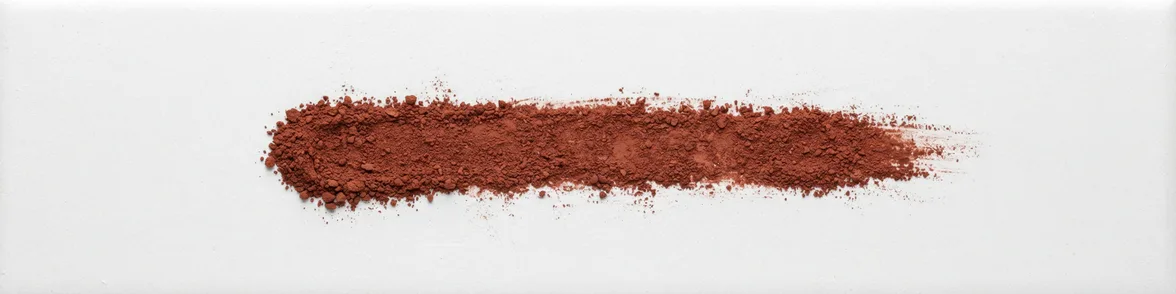
A thin smear is not solid. Most of what is inside the sampled band is powder, and some of it is plate showing through, and averaging the two together turns a strong colour into a weak one — hematite reads a good deal greyer that way than it looks on the tile.
So a pixel counts as deposit only if it sits more than ΔE76 12 from the graded plate, and the streak colour is the mean of the pixels that qualify. What fraction of the band qualifies is worth publishing on its own: it is how thickly the specimen marked, and it is the number the null case falls out of. Below 2% there is no streak.
The rule is weakest exactly where the powder is nearest the porcelain, which is the same blind spot the streak test itself has: rhodochrosite streaks white and only 6.5% of its band is far enough from the plate to be counted. That is stated rather than smoothed over, and it is why the entry for it says its chroma should not be trusted to two places.
| Entry | Deposit | Chroma |
|---|---|---|
| Galena | 100.00% | 1.23 |
| Realgar | 99.99% | 58.58 |
| Atacamite | 98.81% | 51.48 |
| Cinnabar | 98.26% | 61.28 |
| Erythrite | 97.94% | 17.04 |
| Azurite | 95.16% | 34.02 |
| Aurichalcite | 94.73% | 11.51 |
| Magnetite | 91.76% | 0.01 |
| Limonite | 88.29% | 33.78 |
| Pyrite | 77.70% | 4.79 |
| Hematite | 75.21% | 31.97 |
| Sulfur | 73.68% | 13.47 |
| Malachite | 54.76% | 11.19 |
| Rhodochrosite | 6.53% | 5.80 |
| Quartz | 0.42% | 0.00 |
The bare plate, file by file
| Entry | Specimen L* | a* | b* | Streak L* | a* | b* |
|---|---|---|---|---|---|---|
| Cinnabar | 94.12 | -0.04 | -0.01 | 94.09 | -0.14 | 0.24 |
| Erythrite | 94.13 | -0.18 | 0.13 | 94.15 | -0.20 | 0.13 |
| Hematite | 94.13 | -0.15 | 0.24 | 94.06 | -0.01 | 0.01 |
| Realgar | 94.05 | -0.07 | 0.09 | 94.08 | -0.12 | 0.08 |
| Limonite | 94.06 | -0.10 | 0.15 | 94.08 | -0.14 | 0.21 |
| Sulfur | 94.18 | -0.32 | 0.27 | 94.05 | -0.03 | 0.04 |
| Malachite | 94.06 | 0.01 | -0.01 | 94.10 | -0.20 | 0.29 |
| Atacamite | 94.09 | -0.17 | 0.11 | 94.05 | -0.01 | 0.01 |
| Aurichalcite | 94.09 | -0.07 | 0.08 | 94.05 | -0.01 | 0.01 |
| Azurite | 94.12 | -0.33 | 0.42 | 94.08 | -0.06 | 0.03 |
| Pyrite | 94.12 | -0.10 | 0.10 | 94.12 | -0.08 | 0.05 |
| Galena | 94.06 | -0.06 | 0.07 | 94.10 | -0.11 | 0.04 |
| Magnetite | 94.19 | -0.13 | 0.23 | 94.07 | -0.03 | 0.02 |
| Rhodochrosite | 94.05 | -0.12 | 0.09 | 94.12 | -0.05 | 0.09 |
| Quartz | 94.08 | -0.06 | 0.07 | 94.04 | 0.01 | -0.01 |
Target 94 / 0 / 0. The residuals are what a lossy encode does to a flat field, and they are recorded rather than rounded away.